
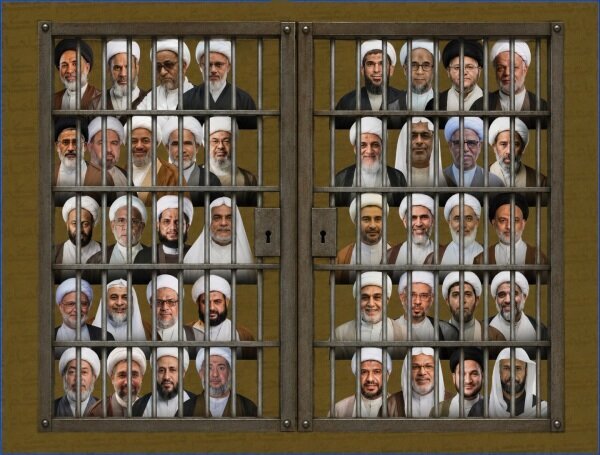
Hawzah News Agency- According to a report by the Bahrain Mirror, what began with highly publicized security statements and trumped-up allegations of transnational crimes has descended into a deafening silence—one that swallows human beings behind closed doors.
Detention Centers Unknown, Basic Rights Denied
The true picture now emerging stands in stark contrast to the official narrative. The detained scholars—many of them well-known figures in religious discourse, social guidance, and public religious activities—are being held in unknown locations. Reports confirm they have been systematically denied access to medicine, clothing, and personal belongings. Their lawyers face threats, and the detainees themselves are barred from contact and family visits.
The case has now reached a six-month prolonged detention period, targeting exclusively Shia clerics.
A Religious Environment Reframed as a Crime Scene
Sources close to the case reveal that the story is not about an armed cell discovered in the shadows, as authorities claim. Instead, prosecutors have transformed an entire religious environment into a theater of accusation. The elements of this so-called case include Khums (Islamic alms), religious proxies, religious gatherings, relations among scholars, and even personal money belonging to wives and children's savings boxes.
Lawyers Targeted, Justice Mocked
The treatment of defense lawyers has exposed the true nature of the proceedings. Most attorneys appointed to represent the detainees were never even invited to interrogation sessions held weeks after the clerics were taken into custody by the intelligence apparatus.
Those who did manage to attend responded to what amounted to a single ring on their phones—a tactic designed merely to prove the lawyer had been "notified." When some lawyers protested this charade, the Public Prosecution threatened to refer them to the disciplinary council.
This is the state of justice under Bahraini authorities: the lawyer is prevented from attending, the detainee is denied access to legal counsel, and the prosecution—supposedly the guardian of investigative procedure—becomes part of the machinery of intimidation.
Evidence So Flimsy It Borders on Scandal
Those lawyers who managed to attend interrogation sessions emerged with a shocking assessment: the evidence presented against the scholars is scandalously weak.
The case of Sheikh Jafar Ashour illustrates the security apparatus's twisted logic. Known in Bahrain for his social work, family reform efforts, and counseling of young couples, Sheikh Ashour was reportedly detained for praising Sheikh Hani al-Banna at a gathering. Since when does praise constitute membership in an allegedly fabricated organization?
Inquisition, Not Investigation
The interrogation questions themselves have laid bare the depth of the legal crisis. Some detained clerics were asked about the locations where they pray, followed by questions about the difference between the "Guardianship of Imam Ali (peace be upon him)" and the "Guardianship of the Jurist." These are the questions of a religious inquisition, not a criminal investigation as authorities claim.
The state is not pursuing a legal criminal act; it is dismantling the beliefs of an entire community in order to reassemble them as a crime.
Everything Shia Is a Crime
Today, everything that occurs within the Shia religious sphere is liable to be reconstructed as evidence of a crime: a gathering, a sermon, Khums payments, religious authority, social ties, or financial donations. Authorities confiscated property from the scholars' homes without distinguishing between the detainees' own funds and those belonging to their families. Even children's piggy banks and electronic devices used for remote learning were seized under a single sweeping pretext.
A Political Decision in Search of a Legal Formula
What deeply concerns observers is that the judicial proceedings did not begin with evidence, but with a statement by the Interior Minister. The atmosphere surrounding the case does not resemble a judicial inquiry; it is closer to a political decision in search of a legal formula. The Interior Minister issued the narrative, the Public Prosecution is busy constructing it, and the judges will attempt to tailor it into sentences of a specific size to satisfy a thirst for deterrence or vengeance.
Where Are the Clerics Being Held?
Meanwhile, the families of the abducted scholars remain gripped by a pressing question: Where are their loved ones being detained? Are they at the Criminal Investigation Directorate? In National Security buildings? Or have they been transferred to Building 15 at Jau Central Prison—a facility recently linked to the death of a detainee under torture?
A Brutal Message to the Entire Shia Community
The unfolding case of these scholars places the very meaning of law in Bahrain under a serious test. What is on display is not a search for truth, but a system that imposes its narrative by force. As the behind-the-scenes reality reveals, this case does not target a security organization—it represents an attempt to control the entire Shia religious sphere. It sends a brutal message to every scholar and pulpit speaker: any religion that does not align with the regime's approach can be dressed in the garb of treason at any moment.


Your Comment