

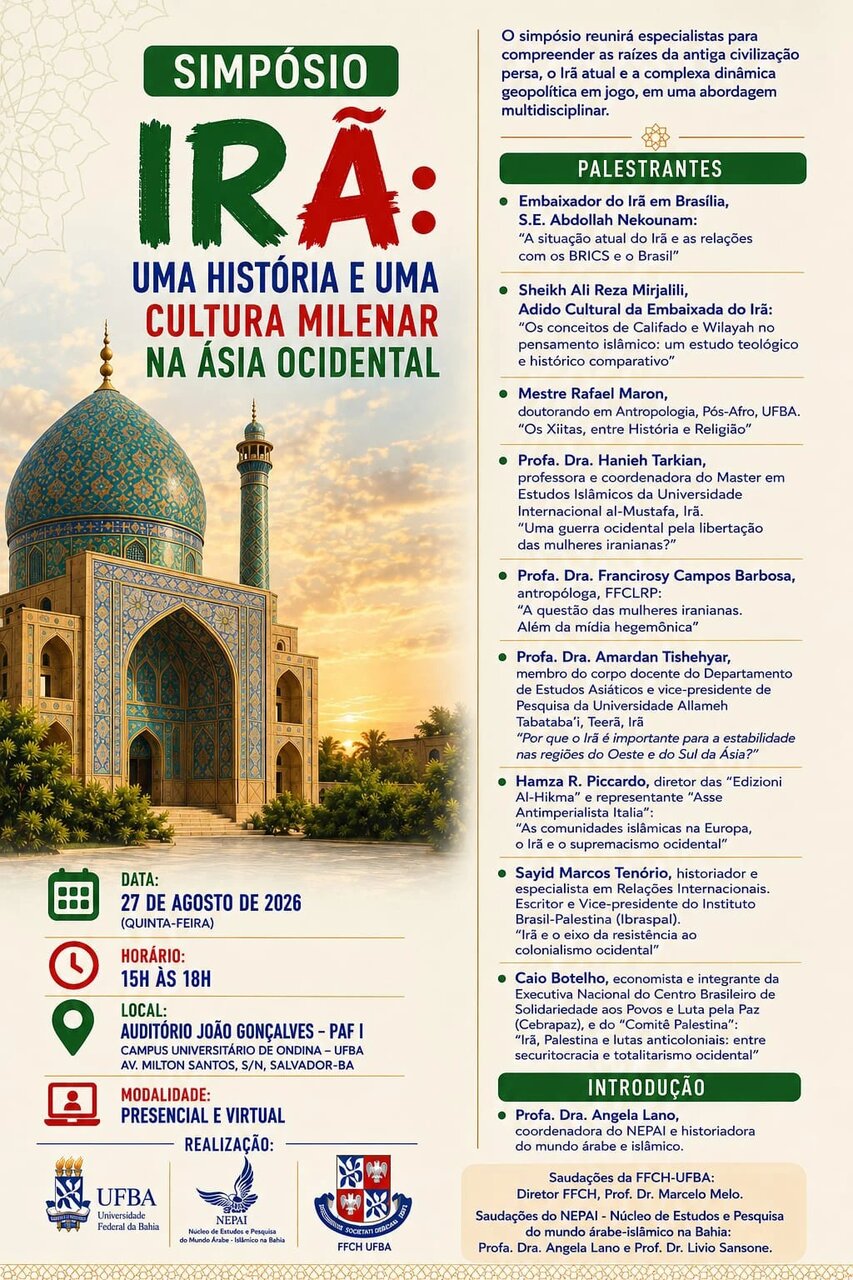
Hawzah News Agency- The event, titled "Iran: A Millennia-Old History and Culture in West Asia," was organized through cooperation between the Federal University of Bahia (UFBA), the Bahia Center for Arab and Islamic World Studies (NEPAI), the university's Faculty of Philosophy and Human Sciences, and the Cultural Office of the Islamic Republic of Iran in Brazil.
The conference took place on August 27, 2026, at the university's Ajro Gonçalves Hall in Salvador, bringing together researchers from both nations to examine Iran's civilizational heritage and contemporary dynamics.
Confronting Distorted Narratives
In an exclusive interview following the conference, Hojatoleslam Alireza Mirjalili, Cultural Counselor at the Iranian Embassy in Brasilia and one of the event's keynote speakers, explained the driving motivation behind the initiative.
"In Brazilian academic circles, understanding of Iran is largely shaped through Western media channels and distorted narratives," Mirjalili said. "Yet Iran is a civilization stretching back thousands of years with a profound scientific, cultural and mystical heritage."
The cultural counselor said the embassy, in cooperation with well-intentioned Brazilian intellectuals, sought to establish a multidisciplinary academic framework to present ancient Iranian history, contemporary Iran and the geopolitical complexities of West Asia in a single forum.
"The result was this conference, which was met with remarkable enthusiasm from students and professors alike," he noted.
Explaining Imamate and Wilayah to a Latin American Audience
Mirjalili's address focused on "The Concepts of Imamate and Wilayah in Islamic Thought: A Theological and Comparative Historical Study."
He explained that one of the most serious questions among Latin American researchers concerns the intellectual structure of Shia Islam and its distinctions from other Islamic schools of thought.
"Imamate and Wilayah form the core of Shia theology, and understanding them enables a proper comprehension of the Islamic Revolution and the Islamic Republic of Iran's system," Mirjalili stated.
He emphasized that presenting these concepts through academic methodology rather than sloganeering generated profound questions from attendees, noting that Brazilian academic audiences — shaped by Catholic theological traditions — possess significant capacity for comparative theological discourse.
Scientific Diplomacy in Action
The presence of Iran's Ambassador to Brazil, Abdullah Nekounam, who delivered remarks on Iran's position and relations with BRICS and Brazil, signaled that the conference transcended a purely cultural gathering.
"This event was part of the explanatory diplomacy of the Islamic Republic of Iran in Latin America," Mirjalili said.
The participation of Dr. Hanieh Torkian from Al-Mustafa International University and Dr. Mandana Tishehyar from Allameh Tabatabai University demonstrated the academic bridge between Iranian seminaries, universities and Brazilian academic institutions.
"Al-Mustafa University and centers affiliated with Islamic seminaries serve as the scientific and explanatory arms of the system internationally," Mirjalili emphasized. "Their presence in such forums represents the very 'scientific diplomacy' emphasized by Iran's leadership."
Challenging Western Narratives on Iranian Women
The conference dedicated two separate sessions to the portrayal of Iranian women in Western media, a topic of particular sensitivity in Brazil.
Dr. Torkian presented "A Western War for the Liberation of Iranian Women?" while Brazilian anthropologist Dr. Francirus Campos Barbosa addressed "The Question of Iranian Women: Beyond Media Hegemony."
"A positive development was that even non-Iranian researchers concluded that Western portrayals of Iranian women are selective and instrumental," Mirjalili said. "The genuine capacities of Iranian Muslim women — in scientific, social and managerial spheres — are entirely overlooked in Western narratives."
He noted that the validation of this analysis by a non-Muslim Brazilian anthropologist proved far more effective for the audience than statements from Iranian speakers alone.
Iran at the Heart of Resistance Discourse
The conference also featured speakers from Brazilian solidarity movements with Palestine, including representatives from the Brazil-Palestine Institute (Ibraspal) and the Brazilian Center for Solidarity with Peoples and the Struggle for Peace (Cebrapaz).
Presentations included "Iran and the Axis of Resistance Against Old Colonialism" and "Iran, Palestine and Anti-Colonial Struggles."
"Iran stands at the heart of the resistance movement and solidarity with the Palestinian nation — this is no secret to Brazilian social activists," Mirjalili said.
He noted that the Brazilian people, having lived through their own history of anti-colonial struggle, understand Iran's narrative as one of resistance rather than mere geopolitics.
Strategic Horizons in Latin America
Assessing the conference's impact, Mirjalili highlighted Brazil's strategic importance, noting the country's population of over 200 million and its position as home to Latin America's largest Muslim and Arab-descended communities.
"The next step is transforming these individual meetings into sustainable cooperation — including chairs of Iranian studies, Persian language courses and researcher exchange programs," he said.
A Call to the Next Generation
Addressing seminary students and scholars interested in international engagement, Mirjalili framed the work as essential to confronting soft warfare.
"The field of explanation is neither optional nor secondary," he declared. "My experience in Brazil has proven that the world is thirsty for understanding Islam. If we do not step forward, this space will be filled by hostile currents and Wahhabism."
He concluded by praising the international news service of the seminary news agency for its pioneering role in reporting such events.


Your Comment