

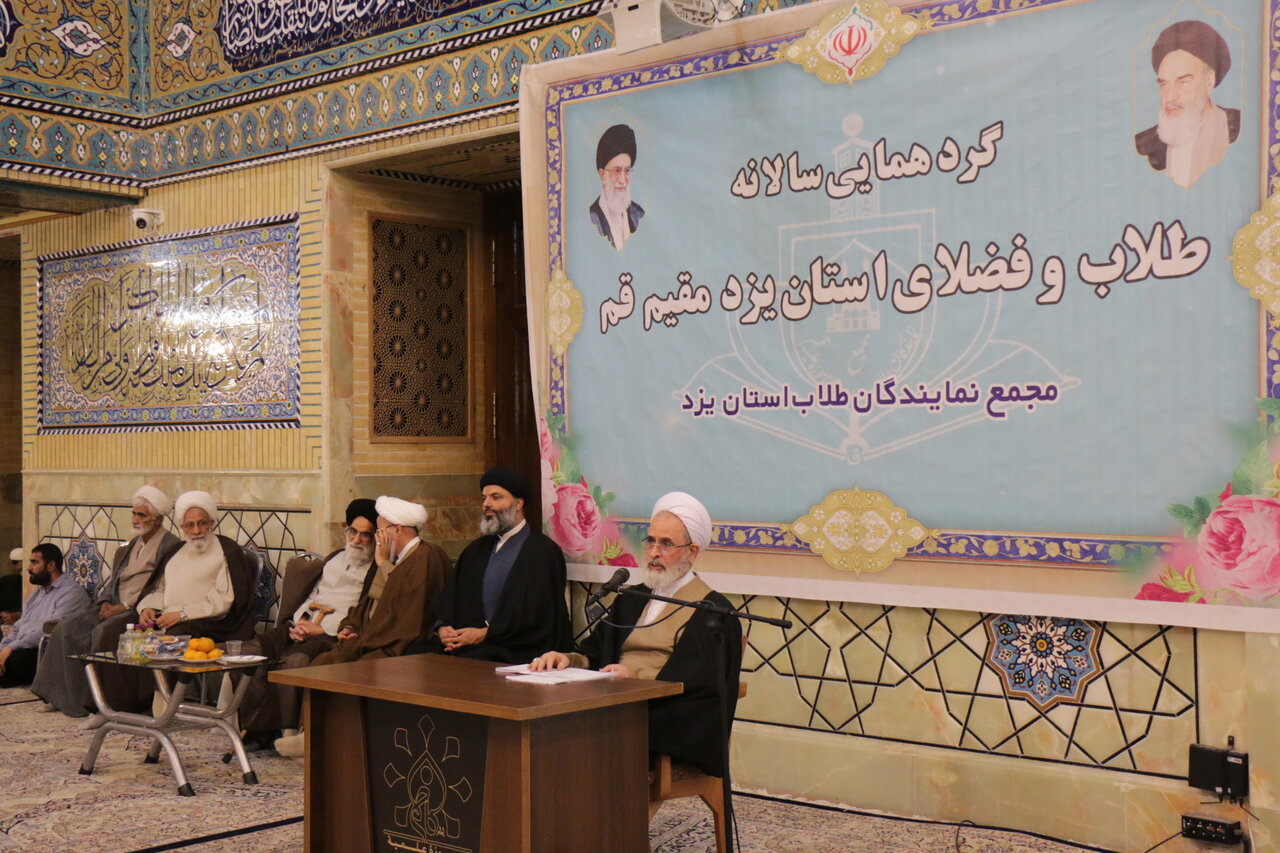
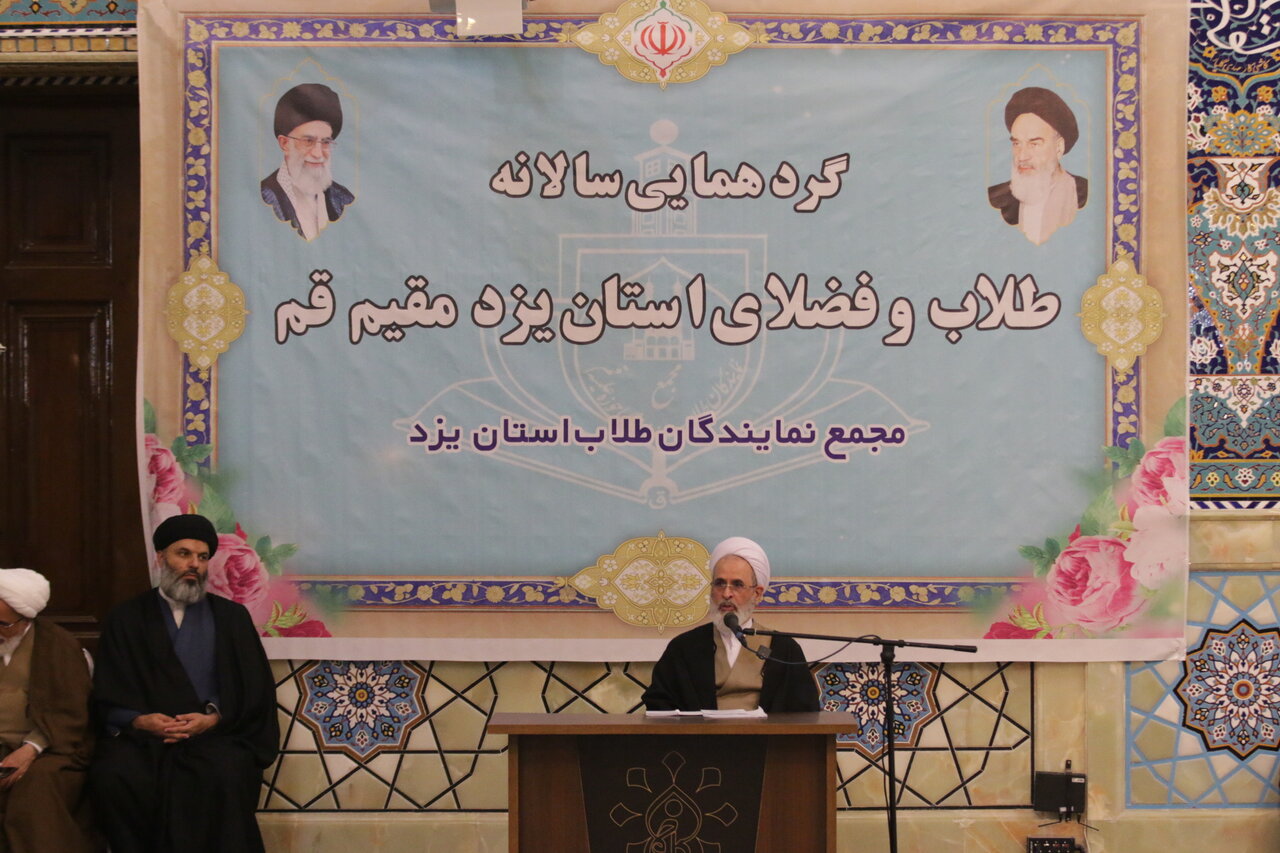
Hawzah News Agency- Speaking at a gathering of Yazdi clerics and seminary students residing in Qom, held Sunday evening at the Imam Kazem Seminary, Ayatollah Arafi congratulated attendees on the birth anniversary of Hazrat Fatima Zahra (PBUH) and marked Basij Week. He devoted his address to the legacy of Fatima's Fadak Sermon, recent regional developments, the resistance front, and the seminary's expanding academic and administrative programs.
'A Historic and Civilizational Crossroads'
Ayatollah Arafi, who also serves as a member of the Guardian Council's jurists, opened by paying tribute to the prophets, religious scholars, and some 5,000 clerics martyred throughout Shia history and the Islamic Revolution, including figures such as Murtaza Motahhari, Mohammad Beheshti, and Mohammad Ali Saduqi. He described the current moment as "the middle of a great historical and civilizational battle," calling for divine assistance for the Iranian nation, the armed forces, the resistance front, and Supreme Leader Ayatollah Sayyed Mojtaba Khamenei.
Fadak Sermon: A Comprehensive Charter for Humanity
Turning to the birth anniversary of Hazrat Fatima Zahra, Ayatollah Arafi described the Fadak Sermon as "a truly human-building, global, and extraordinarily compelling charter," noting that few texts attributed to the Infallible Imams match its comprehensiveness and structural precision. The sermon, he said, begins with theological foundations before moving into sensitive political analysis of the Muslim community immediately after the Prophet's death.
He noted that the sermon has been cited in authoritative Shia sources and in Sunni works dating to the second and third Islamic centuries. "Beyond questions of chain of transmission, the historical evidence, multiple narrations, coherence of text, strength of content, and the epic, impassioned spirit of this sermon give it a set of rare characteristics," he said.
Ayatollah Arafi highlighted the circumstances in which Fatima (PBUH) delivered the sermon—during one of the most difficult periods in Islamic history, amid hostility, uncertainty, and political upheaval. He drew a parallel between Hazrat Khadija, Hazrat Fatima Zahra, and Hazrat Zainab (PBUT), noting that all three appeared at historical turning points when society desperately needed clarity and many had lost the ability to discern the truth. "In such an atmosphere, a small group of discerning individuals, such as Salman, stood against the darkness," he said.
"Her role at this juncture of history transcends a limited historical event," Ayatollah Arafi said. "Through her action and clarification, she illuminated the path of guidance not only for the people of her time but for future generations and all seekers of justice throughout history."
The Unity of God as a Living Reality
Ayatollah Arafi also examined the sermon's theological passages, noting that Fatima presented a coherent vision of divine unity and blessings despite the grief and pressures surrounding her. "The wonder is that a young woman, in conditions filled with sorrow, pressure, and hostility, presents such a deep epistemic system with such precision and elegance in a few short phrases," he said.
He stressed that the declaration of God's oneness is not merely a verbal or doctrinal statement but must manifest in human life, culminating in sincerity—"where the human heart is attached to no reality other than God, and all inclinations, motivations, and movements are directed toward divine satisfaction." He added that monotheism is intertwined with human nature and illuminates both reason and thought, and must appear in all dimensions of individual and social life.
Ayatollah Arafi also noted Fatima's acknowledgment of the limits of human language, mind, and perception in describing God's grandeur. "However much a person strives to describe God, language falls short of expressing the truth of divine greatness," he said. "The human mind, however creative and capable, cannot encompass the infinite reality of God." He said this carries an important message for seminaries: they must cultivate such epistemic and scholarly depth alongside their social and political engagement.
'Third War' Comparable to the 1979 Revolution
In his second major theme, Ayatollah Arafi addressed Iran's current circumstances and the resistance front. He said the "third war" constituted a historic and fateful turning point that, despite heavy losses—including a martyred imam and prominent national figures—should be compared to the February 1979 victory of the Islamic Revolution. "That day, too, created a great shift in global and regional equations and seriously challenged prevailing analyses and calculations," he said.
He argued that before the revolution, much of the world's scholarly and political establishment believed religion had reached its end and could no longer play a determining role in social and political life. "Many theorists were convinced that the era of political religion and religiously based movements had ended, and that new civilizational and political models would replace them—but Iran's Islamic Revolution upended these equations," he said.
Ayatollah Arafi stressed that the core of the confrontation with the Islamic Republic is not about energy, oil, or economic disputes. "If the issue were merely a few economic, energy, or political differences, negotiation and common ground would be possible," he said. "But the fundamental issue is a difference in foundations and discourse. The Islamic Republic moves according to a different logic and different principles, and this is the main focal point of many confrontations."
A Nation That Defied Expectations
Reflecting on his recent travels to Malaysia, Iraq, and Bosnia, Ayatollah Arafi said friends and adversaries alike remain astonished by Iran's resilience during the "third war." "Even many who had prior ties and familiarity with the Islamic Republic did not imagine that the Iranian nation could stand firm under such conditions and against such a vast array of pressures and threats," he said.
He noted that many observers had predicted the collapse or disintegration of Iran's core structures under the combined military, security, political, and economic pressure. "Not only did the country not collapse, but the Iranian nation, relying on faith, will, cohesion, and a spirit of resistance, created a different scene," he said. "Foreign analysts assessed developments through conventional military and political calculations but failed to properly account for the spiritual, social, and faith-based capacities of the Iranian nation."
Ayatollah Arafi said the resistance demonstrated a capacity that cannot be easily measured by ordinary political and military calculus. He also pointed to growing international interest in Iran, particularly among Muslim nations and Sunni figures from African countries, describing this as an opportunity for a broader cultural and communications effort. "Africa is a very important continent with a broad future," he said, calling for strengthened ties with its peoples, elites, religious figures, and cultural institutions.
Regional Relations and the Resistance Front
Ayatollah Arafi expressed hope that under the Supreme Leader's guidance, Iran would pass through this stage with dignity and review regional considerations from previous years with greater precision. He recalled that during the eight-year Iran-Iraq war, several regional and international powers stood against Iran—experiences, he said, that must remain in the nation's historical and political memory.
On the resistance front, particularly in southern Lebanon, he acknowledged severe destruction and heavy attacks but said the morale of the people and resistance forces remains notable. "What is observed in these areas reflects the depth of faith and perseverance of a people who, despite enduring great losses, have not abandoned their ideals," he said.
Seminary Expansion and Decentralization
In his final section, Ayatollah Arafi outlined the seminary administration's efforts in recent years, focused on two main approaches: increasing provincial authorities and enhancing their academic, educational, and managerial capacities. He said formal advanced-level courses now operate in more than 50 locations outside the main seminary centers, alongside significant expansion in specialized fields and research. More than 25,000 people are now active in various scholarly and research networks, he said.
On religious outreach, Ayatollah Arafi stressed that propagation must be tailored to the needs of society, the cultural and social conditions of different regions, and the demands of the younger generation. "A single template cannot be applied to all regions of the country," he said, calling for the use of local capacities and talent.
A Charge to Young Clerics
Addressing young seminarians, Ayatollah Arafi said the future of the Muslim world depends on their efforts, perseverance, and scholarly depth. With the global population at roughly eight billion and demographic and social changes underway, he said, humanity's intellectual and cultural needs will only grow. "Preparing great scholars who can answer the needs of future generations is no easy task," he said. "It requires continuous effort, tolerance of hardship, scholarly striving, self-purification, and a long-term vision."
He urged young clerics to endure difficulties and prepare themselves for major responsibilities ahead. "Seminaries must be able to play a role commensurate with the needs of the Muslim world and human society," he said.

Your Comment