
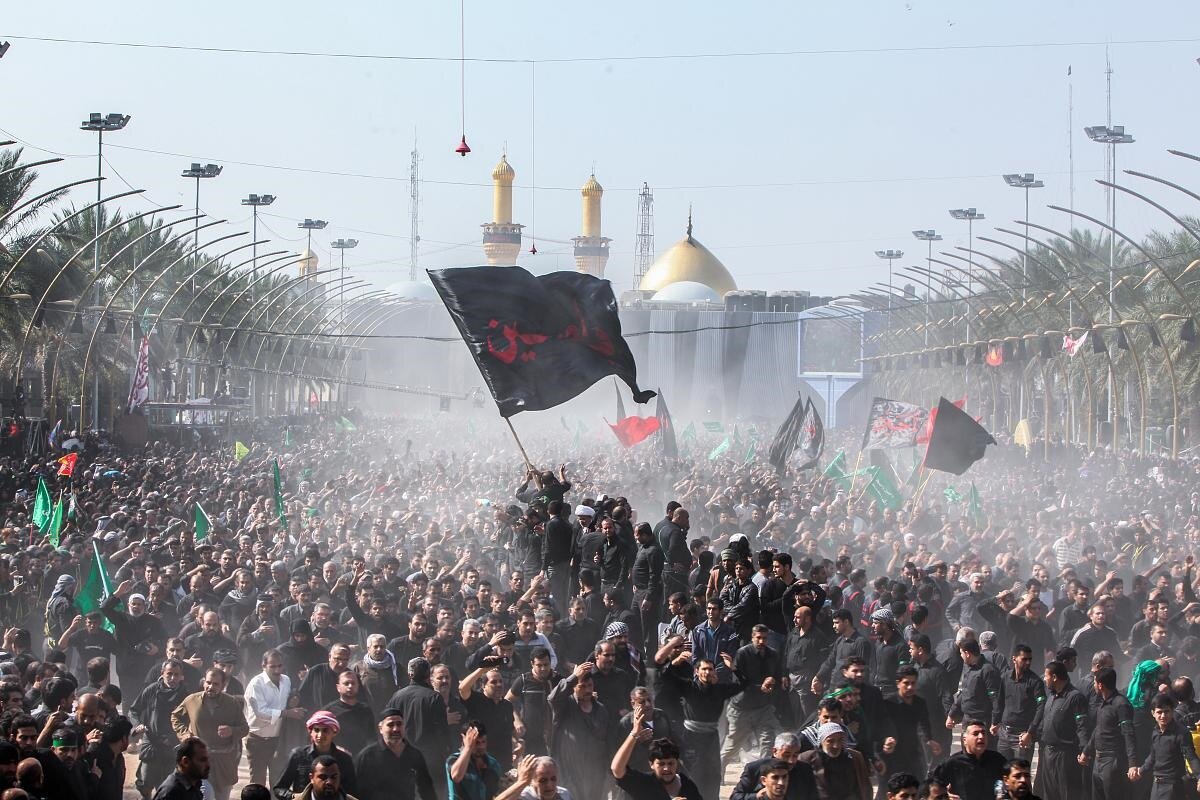
Hawzah News Agency- The event, which became known as the Safar Intifada, left approximately sixteen dead, thousands arrested, several executed, and many more sentenced to lengthy prison terms. Public observance of the march remained suppressed until the fall of Saddam Hussein in 2003. Following his overthrow, the Arbaeen pilgrimage was revived with millions of participants, transforming into one of the largest annual religious gatherings on earth.
Historical Roots of Repression and Early Confrontations
Ba'athist restrictions on Shia religious ceremonies began in 1969 and intensified steadily. In the early years, observances were confined to a limited number of licensed Hussainiyas and venues. By 1975, an explicit order was issued banning the Arbaeen foot pilgrimage to Karbala and prohibiting the establishment of hospitality Mawkibs. In 1976, control measures escalated dramatically. During the first ten days of Muharram, security forces searched vehicles on routes leading to religious cities, confiscating any flag, black clothing, or item associated with mourning rituals.
The holy city of Najaf, a major center of Shia scholarship and religious activity, bore the brunt of these policies. On the night of the ninth of Muharram, corresponding to late February 1970, local authorities ordered the main gates of the shrine of Imam Ali—including the Bab Muslim ibn Aqil and Bab Sheikh Tusi entrances—to be locked. The move triggered an immediate backlash from residents. A protest gathered, and participants advanced on security personnel using objects found at the site. One of the shrine's chambers, where officers and local officials—including the deputy governor of Najaf and a Ba'ath Party official—were stationed, was stormed. In the chaos, one of the shrine doors was forced open, a development witnesses described as unexpected, further energizing the crowd. The police communications post was subsequently attacked, and part of its equipment was destroyed. Reinforcements arrived and opened fire, but sporadic clashes continued until midnight. One person was killed and several wounded. In the aftermath, security forces imposed broader preemptive measures, including intensified night patrols and tighter controls on city entry points.
Escalating Unrest and Mounting Tensions in the 1970s
Despite the crackdown, Muharram and Arbaeen observances persisted in the years following the 1970 events. On the night of Ashura in early 1975, larger demonstrations erupted in Najaf. This time, participants carried bladed weapons. After marching through the central market and streets, they entered the shrine courtyard of Imam Ali (PBUH), where a speaker delivered direct criticism of Ba'ath Party policies. During Arbaeen that same year, in May 1975, security forces erected images of Hassan al-Bakr and Saddam Hussein along the pilgrims' route. The crowd responded furiously, tearing down the portraits and transforming the mourning procession into a political protest. Slogans against the Ba'ath Party and its two top leaders rang out, with participants openly declaring their opposition to the regime.
Clashes between security forces and mourners also occurred in early 1976. This sequence of events heightened local readiness for the following year, setting the stage for a larger, more organized movement during Arbaeen in February 1977.
On the night of Ashura in late January 1977, a group of young men marched carrying a flag promoted as a symbol of sacrifice. Armed with bladed weapons, they engaged in direct confrontation with security personnel. Several officers were wounded, and regime forces temporarily retreated. A number of participants were subsequently arrested and interrogated. A protest planned for the 25th of Muharram—marking the death anniversary of Imam Ali ibn Hussein (PBUH)—was postponed for security and organizational reasons, rescheduled to coincide with Arbaeen.
The Arbaeen March of 1977 Begins
By February 1977, Saddam Hussein had not yet formally ousted Hassan al-Bakr, but his influence within the Ba'ath Party and state decision-making was growing rapidly. Restrictions on religious ceremonies persisted, and on the night of Ashura, a number of young mourners were arrested. After consultations with Ayatollah Mohammad Baqir al-Sadr, the decision was made to postpone protests until Arbaeen. Several religious authorities had also recommended undertaking the Arbaeen pilgrimage at that juncture.
Eleven o'clock on the morning of 4 February 1977 was set as the departure time. The crowd swelled gradually through the streets of Najaf, ultimately numbering around thirty thousand gathered in the vicinity of the shrine of Imam Ali (PBUH). Preachers and orators played a significant role in urging participation and providing initial organizational direction. Amid the crowd, banners bore Quranic verses such as "Help from Allah and an imminent victory" and slogans including "Our motto is love for Hussein; we sacrifice our blood for you, O father of the martyrs." Participants chanted vows to press forward even at the cost of life and limb.
The mass of people departed Najaf and reached Khan al-Rubu, roughly ten kilometers outside the city, where they spent the night. Women contributed to the effort by welcoming marchers and helping to supply basic provisions. Defensive measures were adopted to protect the crowd: stones were gathered for potential clashes with security forces, and access roads were monitored. Vehicles carrying food that had been confiscated by authorities were liberated by the crowd, and limited skirmishes forced a temporary retreat by regime forces.
The March Continues: Mid-Route Clashes
After dawn prayers on 5 February 1977, the march resumed from Khan al-Rubu. Participants took control of the main Najaf-Karbala highway. Public vehicles were inspected; any images of Hassan al-Bakr or Saddam Hussein were torn down. Sporadic clashes erupted between marchers and security forces along the route. Roughly fifty kilometers from Karbala, a more serious confrontation occurred, resulting in the deaths of four participants. Despite these casualties, the march pressed on. A heavy downpour in the evening and plunging temperatures hampered the advance of Republican Guard units, enabling the crowd to reach Musayyib, approximately thirty kilometers from Karbala.
Military Crackdown Near Karbala and Immediate Aftermath
Central authorities dispatched the 10th Armored Brigade to the Karbala Road with orders to intercept and, if necessary, open fire. MiG fighter jets roared over the crowd and the city of Karbala. Two aircraft passed at extremely low altitude, breaking the sound barrier and shattering vehicle windows. Tanks, armored personnel carriers, police vehicles, and hundreds of armed troops were then deployed to the area.
During the encirclement, some deployed soldiers defied orders and joined the marchers. Two aircraft also crashed—one into Lake Razzaza near Karbala and another near Musayyib. Subsequent technical investigations identified no definitive cause, attributing the incidents to mechanical failure. Some participants ascribed the crashes to divine intervention. In several instances, individuals climbed onto tanks, chanting slogans. One marcher threw himself in front of a tank; the crew pulled him aside, stating they were in a similar position.
At Khan al-Nukhayla, roughly twenty kilometers from Karbala, the crowd was completely encircled. Security forces carried out mass arrests. A number of participants managed to escape through secondary routes. By this stage, approximately sixteen people had been killed and thousands detained. Of those arrested, eight were executed and sixteen—including Mohammad Baqir al-Hakim—were sentenced to life imprisonment. Death sentences in absentia were issued for figures outside Iraq, including Morteza Askari, Mohammad Hussein Fadlallah, Mohammad Mehdi Shamseddin, and Mohammad Mehdi Asefi. Seven individuals died during interrogation. Those targeted were overwhelmingly former organizers of mourning gatherings.
The remaining marchers eventually reached Karbala. Participants proceeded first to the shrine of Abbas ibn Ali (PBUH), then to the shrine of Imam Hussein (PBUH), carrying the bloodied clothing of one of the slain. Clashes erupted at the shrine entrances. Security forces sealed most gates and attempted to trap the crowd. Fighting spilled into the surrounding streets. News of the events reached Iraqi prisons, where reactions from inmates were subsequently reported.
Medium-Term Consequences and the Situation Until 2003
The events of February 1977 eroded the Ba'ath Party's political credibility among a significant segment of the Shia population and shattered the regime's aura of invincibility in the public consciousness. One organizational outcome was the formation of the Supreme Council for the Islamic Revolution in Iraq, initiated by Mohammad Baqir al-Hakim, who had earlier been freed under a general amnesty issued by Hassan al-Bakr. This body would play a role in mobilizing opposition groups in the years that followed.
Restrictions and the ban on the Arbaeen pilgrimage remained in force until the fall of Saddam Hussein in April 2003. After his removal, the march was revived. The very first Arbaeen following the regime's collapse—in late April 2003—drew an estimated two to three million participants. In subsequent years, numbers steadily climbed, surpassing ten million. The pilgrimage is now recognized as one of the largest annual religious gatherings in the world.
Less than ten days after Saddam's fall, despite ongoing conflict and severe travel restrictions both within Iraq and from abroad, roughly two million people took part in the Arbaeen pilgrimage. Hospitality services were revived, and alongside religious slogans, banners opposing the American military presence appeared. The crowd moved in close proximity to U.S. forces, under the shadow of Black Hawk helicopters. Mohammad Baqir al-Hakim called on the people to participate, and he himself returned to Iraq days later. On 29 August 2003, he was killed in a bomb attack near the shrine of Imam Ali. His funeral procession drew an enormous gathering, reminiscent of the Arbaeen crowds of earlier decades.
The Arbaeen of 2003, with marchers streaming from cities such as Baghdad and Najaf toward Karbala, marked the beginning of an era of regular and steadily expanding observance—a tradition that has continued and grown ever since.
Adapted from: Raad al-Mousawi Institute for Political Studies and Research, "The Safar Intifada"


Your Comment