
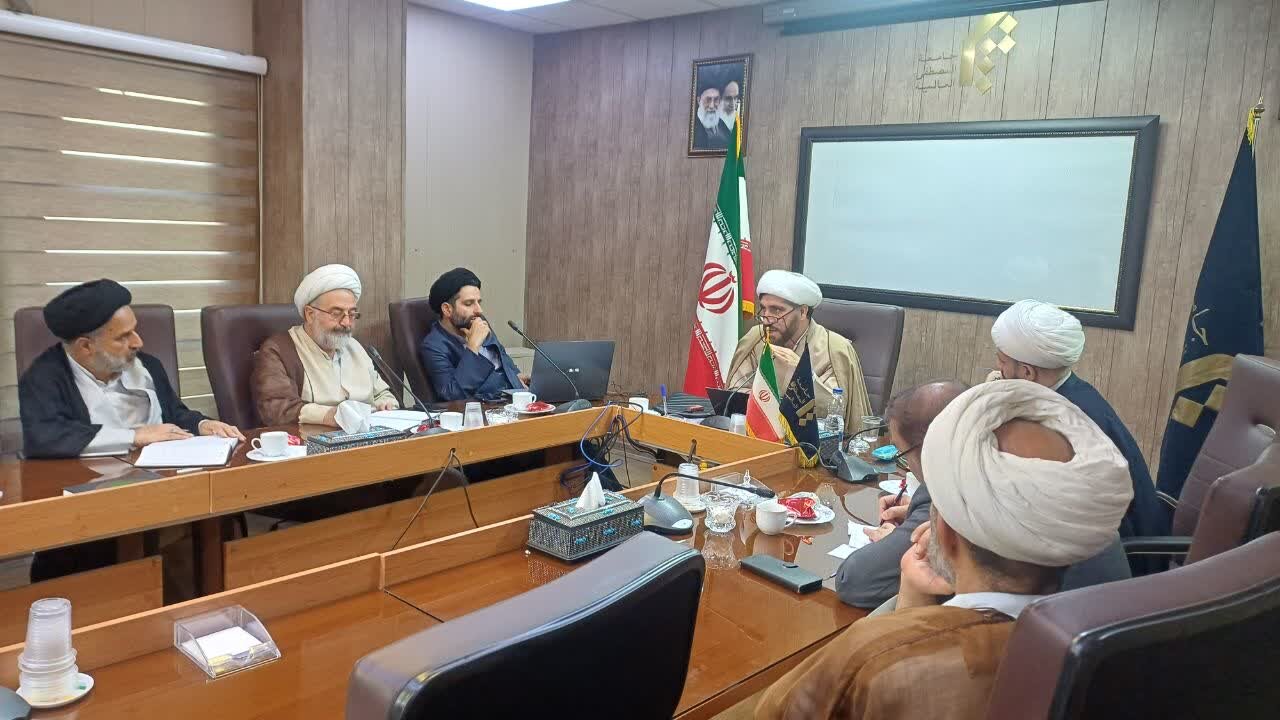
Hawzah News Agency- Speaking at an academic conference titled "Analyzing the Dimensions and Components of Martyr Nasrallah's Popularity and Social Capital," Hojatoleslam Mohammad Ali Mirzaei, head of the Rasoul Akram and Fatemeh al-Zahra seminaries in Lebanon, characterized Sayyed Nasrallah's relationship with the people as existential, emotional, and social in nature.
The Al-Mustafa faculty member cited verse 96 of Surah Maryam — "Indeed, those who believe and do righteous deeds, the Most Merciful will appoint for them affection" — as the key to understanding the martyr's popularity. He stressed that Martyr Nasrallah's appeal cannot be reduced to standard sociological frameworks, arguing it belonged to the category of "divine affection": a profound and enduring connection, born of faith and righteous conduct, that permeated the collective spirit of the community. From this perspective, his relationship with the people was never merely political or organizational, but rather an existential, emotional, and social bond that generated deep public trust and lasting attachment.
Critiquing Max Weber's theory of charisma, Mirzaei argued the model falls short of capturing Nasrallah's personality. Under the Weberian framework, charisma can apply to any exceptional appeal, even in corrupt or authoritarian figures. Martyr Nasrallah's popularity, by contrast, was anchored in honesty, piety, responsibility, and suffering alongside his people. While he was undeniably an influential and commanding presence, that influence must be understood within a framework of faith, ethics, and social commitment — not through a value-neutral sociological concept.
Drawing on the views of Ayatollah Javadi Amoli, the Lebanese seminary director asserted that true religiosity cannot be realized in isolation; it manifests in how one engages with society and the quality of one's connection to the people. Nasrallah, he said, embodied a figure who never divorced spirituality from the social sphere. His influence extended far beyond politics or military resistance, reaching into social education, offering tranquility to society, strengthening public confidence, and providing a sense of refuge and reliance.
Mirzaei described Martyr Nasrallah as an exemplar of "community imamate" — a figure who, transcending the role of a mere manager or commander, served as an axis of unity, discernment, direction, and social cohesion. In Lebanon, his role was never confined to leading a party or political current. For a significant segment of society, particularly among Lebanese Shias, he occupied the position of a sanctuary. People did not merely take orders from him; they drew calm, assurance, and a sense of horizon from his presence. Within such a framework, popularity is not just a media asset but a genuine capacity for community-building and social healing.
The scholar placed particular emphasis on the element of rationality in Nasrallah's leadership, noting that one of his defining traits was the synthesis of theology, spirituality, and practical wisdom. He relied on faith, spirituality, and a spirit of struggle while simultaneously demonstrating realism and prudence in managing society, navigating Lebanon's religious and social diversity, calibrating the tone and timing of his statements, and handling sensitive issues with precision. From this standpoint, Martyr Nasrallah was not merely a heroic figure but a model of wise leadership who knew how to keep Lebanon's pluralistic society aligned with the resistance without compromising its core principles.
Mirzaei highlighted key indicators of Martyr Nasrallah's social and managerial rationality: sustained popularity over three decades even amid war, crisis, and security pressure; the ability to connect with diverse social strata, including critics and non-Shias; and a measured approach to social and cultural issues that safeguarded both the resistance and social cohesion. This comprehensiveness, he argued, transformed Nasrallah into a kind of "social anchor" for Lebanon.
Turning to the question of legitimacy, Mirzaei stated that Nasrallah's standing cannot be explained through classical models of political legitimacy. His legitimacy rested less on formal structures than on a deep and broad-based acceptance — one forged from the fusion of faith, honesty, effectiveness, steadfastness, and a genuine connection with the people. In this sense, Nasrallah was not merely the leader of a movement; he was a figure the community had embraced, and that public acceptance granted him a power transcending any official position.
Addressing Martyr Nasrallah's narrative power, Mirzaei dubbed him the "author of the resistance narrative." He noted that one of the serious weaknesses of the resistance front lies in the domain of media and narrative-building, while the enemy systematically distorts realities through its own narrative construction. Against this backdrop, Nasrallah — with his eloquent, precise, and accessible language — succeeded in reproducing the resistance narrative on a regional and international scale, compensating for significant media gaps. This ability transformed him simultaneously into a leader, spokesperson, social educator, and producer of meaning for public opinion.


Your Comment